

Turbulence is bad enough from an airline seat, where at least you can grip an armrest and tell yourself it’s normal. Lying flat on a stretcher is another thing entirely. You’re hurt, you can’t brace, and the aircraft is bouncing around like a truck on a rutted track. That’s a real hazard for patients moved by medical helicopter. So what holds everything together when the air turns rough? Careful design, mostly, plus hardware far stronger than it looks.
Locked Down Tight
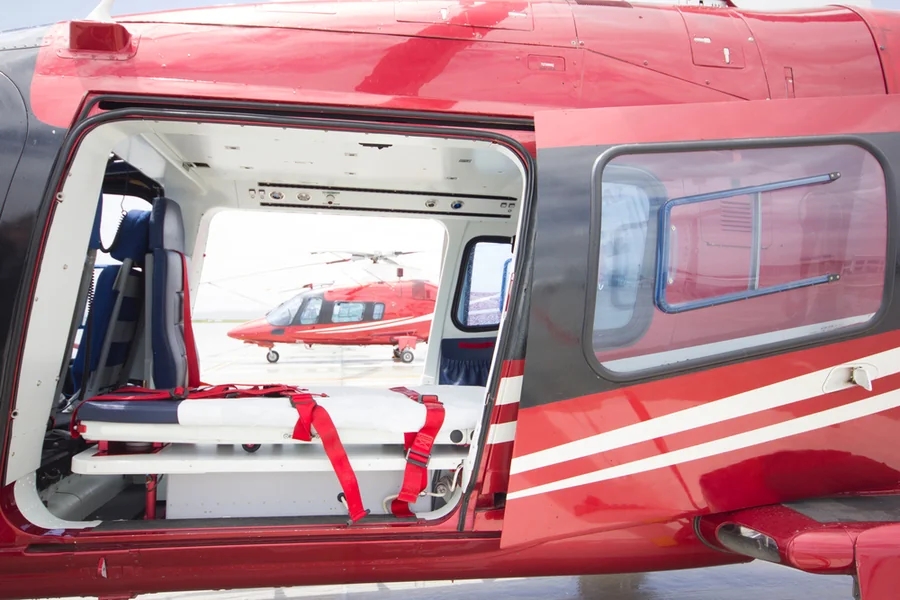
It starts with the stretcher, which isn’t simply sitting on the floor. It clicks into a base, and that base is bolted through to the airframe. Nearest everyday comparison is a child seat in a car, although the engineering standard is a good deal higher. When the helicopter drops, the stretcher doesn’t. No sliding across the cabin, no tipping. The patient moves with the aircraft rather than around inside it, and that single link between stretcher and floor is what the rest of the safety case rests on.
Straps That Do the Heavy Lifting
Locking the stretcher down is only half the job. The patient has to stay on it. Hence the straps: belts running across the chest, over the hips, across the legs, pulled tight enough to stop movement altogether. Nothing flimsy about them. They keep holding through sudden descents and hard banked turns. Moreover, crews tighten them before the aircraft lifts, so nothing works loose later. Turn the whole thing upside down and they’d still hold. Companies like LifePort stand out here, because their air medical stretcher systems for helicopters hold patients steady through the roughest flights, giving crews one less thing to worry about.
The Science of Soaking Up Shocks
Here’s something people rarely think about: a good stretcher system absorbs energy as well as resisting it. When the helicopter hits a pocket of bad air, parts built into the base take some of that force out before it reaches the patient. Matters enormously if you’ve got a spinal injury or a few broken ribs. Less jolting, less pain, often less further damage. The base works as a buffer between a bouncing aircraft and somebody who can’t take another knock.
Keeping the Gear From Flying Around
Patient secure, fine. Everything else in the cabin still needs attention. Oxygen cylinders, monitors, drug bags, all of it has to stay where the crew left it, because a loose cylinder in turbulence is effectively a missile. Everything therefore goes into a mount or under a strap. Crews work in a cabin where nothing drifts, however bad the ride gets, and that protects the patient along with the people treating him.
Why Testing Never Stops
Nothing of this is taken for granted. The bases, straps, and mounts are tested beyond any conceivable damage that may result during a bad flight. The reason for this is simple: it’s necessary to know where a part breaks in order to fix it. That’s why they break, beat, overload the thing until it cracks, change it, and begin anew. By the time a system has made it into flight it already has passed everything that could be thrown at it. This is how pilots can count on it when the weather turns sour.
Conclusion
Turbulence isn’t optional. It comes with flying. For a patient on board, though, it needn’t be dangerous. The stretcher holds. The straps hold. The base takes the sting out of the worst bumps. The gear stays put. All of it together lets the patient ride safely while the crew gets on with treating him. Rough outside, steady inside. That’s the whole idea.
